
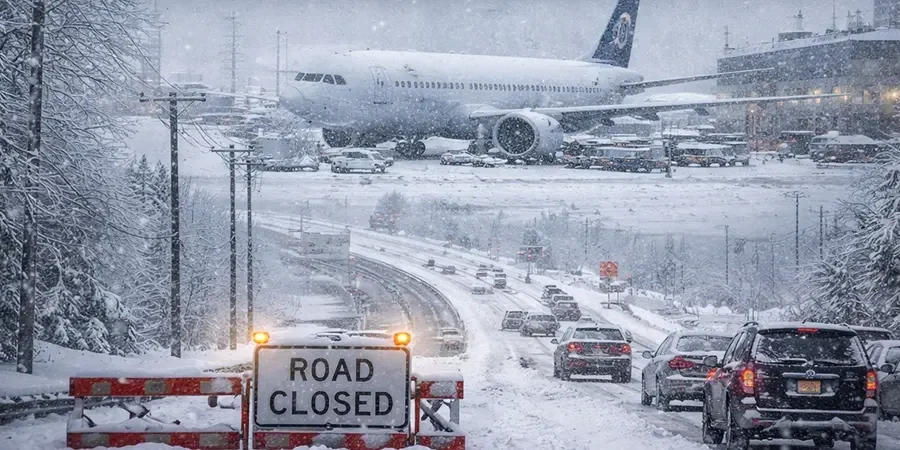
Aviation Halted, Roads Closed, Power Cut to Thousands
A powerful winter storm swept across the northeastern United States this week, bringing blizzard conditions along nearly 700 miles of the East Coast and disrupting daily life from Maryland to Maine.
More than 40 million people were placed under blizzard warnings as heavy snowfall, strong winds, and near-whiteout conditions made travel nearly impossible. Several states issued travel bans at the height of the storm, while roadways along the heavily trafficked I-95 corridor experienced severe disruption.
Widespread Power Outages
As of Tuesday evening, more than 250,000 homes and businesses across the East Coast were without power. Massachusetts recorded the highest number of outages, with approximately 216,000 customers affected, particularly in Barnstable County on Cape Cod.
New Jersey reported nearly 19,000 outages, while Delaware saw around 15,000 customers without electricity.
Aviation Disruption Across Major Hubs
The storm triggered one of the most significant aviation shutdowns of the winter season. More than 11,000 flights were canceled between Sunday and Tuesday, according to flight tracking data.
Air traffic was effectively suspended from Philadelphia northward to Boston during peak conditions. Major hubs including John F. Kennedy International Airport, LaGuardia Airport, Boston Logan International Airport, and Philadelphia International Airport accounted for a large share of cancellations.
Airlines began preemptively grounding flights ahead of the storm, with cancellations peaking on Monday and continuing into Tuesday as airports attempted to resume limited service.

Record Snowfall Totals
Snow accumulation reached historic levels in several areas:
- Over 29 inches reported in parts of Long Island, New York
- More than 26 inches in portions of New Jersey
- Over 19 inches recorded in Central Park, making it one of the largest snowfalls in New York City history
- 37.9 inches reported in Providence, the largest snowstorm on record for the city
In southeastern Massachusetts, numerous communities recorded totals exceeding 30 inches.
Travel Bans Gradually Lifted
As snowfall tapered, state and municipal authorities began lifting travel restrictions. New York City officials ended their nonessential travel ban Monday afternoon, while statewide restrictions in New Jersey were lifted later in the day.
Massachusetts lifted travel bans in several affected counties by Tuesday noon, though officials warned that icy road conditions remained hazardous.
Impact on the Luxury Car Service Industry
The storm’s ripple effects extended beyond commercial aviation and public infrastructure. Luxury car service operators across the Northeast corridor, particularly in New York, Boston, Philadelphia, New Jersey, and surrounding metropolitan areas, faced immediate operational strain.
With airport activity largely suspended, high-value airport transfer bookings were either canceled or indefinitely postponed. Corporate travel itineraries were disrupted, private aviation traffic slowed, and intercity mobility across the region contracted sharply.
However, unlike commercial airlines, luxury ground transportation providers were not uniformly halted. In markets such as New York City and Boston, selected operators like NYC United Limo continued limited service once municipal bans were lifted, primarily serving essential and pre-scheduled corporate clients.
That said, blizzard conditions significantly increased operational risk. Road closures, black ice, reduced visibility, and extended travel times led to:
- Reduced fleet deployment
- Higher liability exposure
- Increased vehicle maintenance strain
- Scheduling backlogs following airport reopening
For operators in snow-heavy regions like Massachusetts and Rhode Island, the event underscored the volatility of winter-season revenue patterns.
A Brief Industry Reckoning
Extreme weather events of this magnitude are becoming more frequent and more disruptive. For the luxury car service sector, particularly in the Northeast, reliance on airport traffic and tightly scheduled corporate mobility creates measurable vulnerability during aviation shutdowns.
This storm highlighted a structural reality: when commercial aviation stops, the ripple effects cascade across premium ground transport almost instantly. The industry may increasingly face the need to balance fleet investment, weather resilience, and diversified revenue streams against seasonal unpredictability.
In the Northeast corridor, winter is no longer just a seasonal slowdown, it is an operational stress test.


