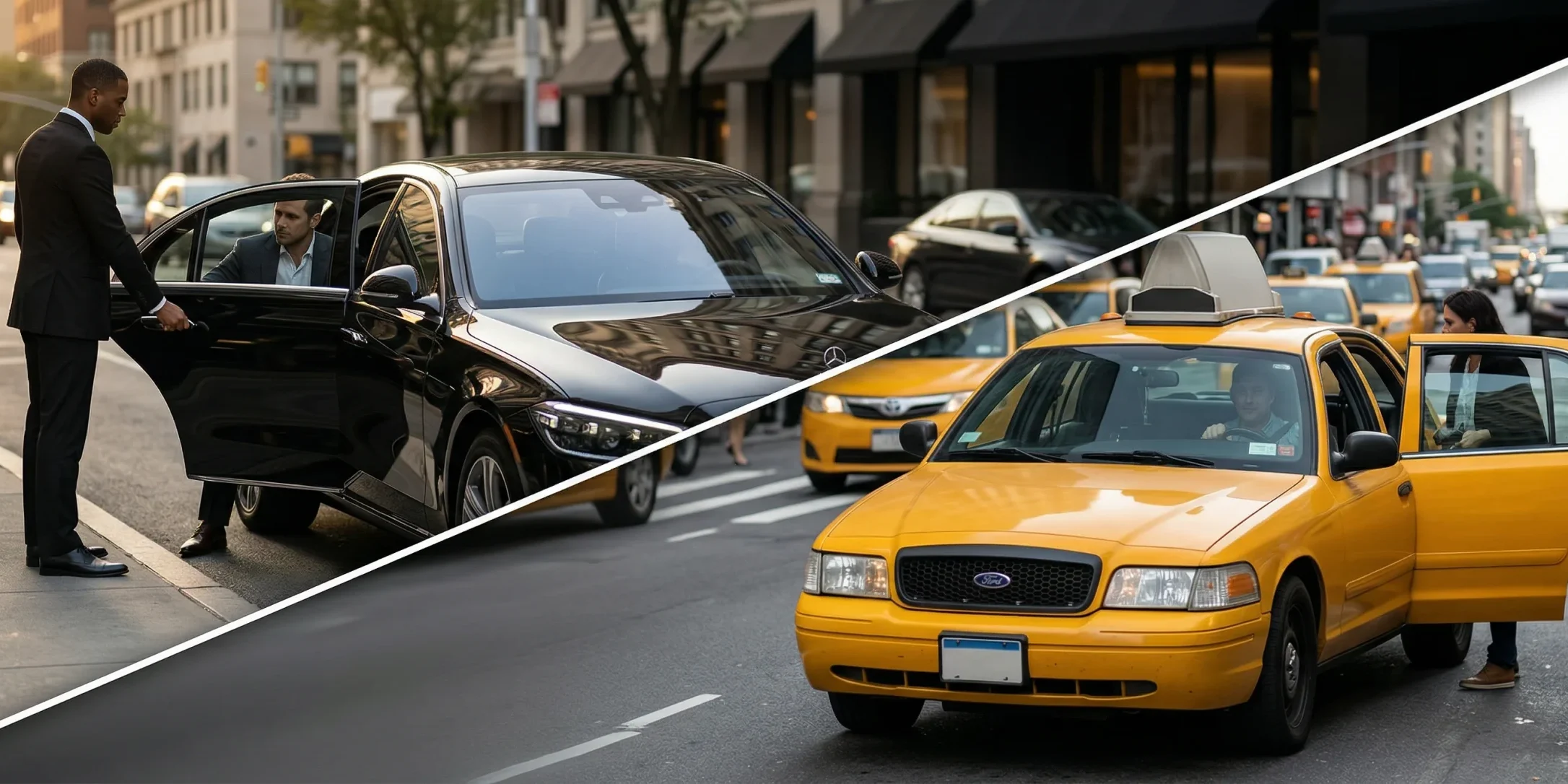
Car Service vs Taxi: Key Differences and How to Choose What’s Right for You
Thinking about car service vs taxi? Need a ride right now? Take a taxi. Have a flight or important meeting? Book a car service.
Taxis charge by the meter and can get expensive in traffic. Car services give you a flat rate upfront and track your flight for airport pickups.
Here’s exactly how to choose between them for your next trip.
From our experience: We regularly see clients switch from taxis after inconsistent airport experiences, like waiting 45 minutes in a JFK taxi line at midnight, only to find a driver who doesn’t know Brooklyn. The same travelers now book car services and walk straight to a waiting driver with their name on a sign.
Best Option Based on Your Situation – Quick Picks
| If you are… | Choose this | Why |
| Alone, light bag, off-peak hours | Taxi | Cheaper and easier to find |
| Family of 4 with luggage | Car Service | Flat rate, guaranteed space |
| Business traveler with a laptop | Car Service | Privacy, phone charger, Wi-Fi |
| Late night in Manhattan | Taxi | Hail on street, no wait |
| First time at JFK | Car Service | The driver meets you with a sign |
| On a strict budget | AirTrain + Subway | $11.40, but with luggage it’s tough |
Understanding the Core Definition of Each
Immediate-Hire Taxi
A taxi is a vehicle you can hire immediately. In New York City, yellow taxis are regulated by the Taxi and Limousine Commission (TLC). You can hail one on the street by looking for the center roof light. If the numbers are lit, the taxi is available. Stand near the curb, make eye contact with the driver, and raise your arm.
You can also find taxis at designated stands outside airports, hotels, and major transit hubs. Taxis are ideal for spontaneous trips. You decide you need to go somewhere, and within minutes, you are on your way.
In most cities, the words “taxi” and “cab” mean the same thing: a vehicle you can hail on the street.
Pre-booked Car Service
A car service works differently. You cannot hail one on the street. Instead, you book in advance by phone, app, or website. You provide your pickup location, destination, and desired time. The company assigns a driver who arrives at the scheduled time.
Car services are designed for planned travel. Common uses include airport transfers, business trips, weddings, and any occasion where reliability and punctuality are essential. Many car services also offer flight tracking; they monitor your flight and adjust pickup time automatically if your arrival is delayed.
While both offer pre-arranged rides, traditional car services focus more on consistency, professional driver standards, and surge-free pricing.
Booking, Availability, and Reliability
Street-Hail Taxi
With a taxi, you do not book ahead. You find one when you need it. In Manhattan, taxis are abundant. You can typically find one within minutes on major avenues like Broadway, Park Avenue, or near transportation hubs.
However, availability is not guaranteed. During rainstorms, rush hour (4:00 PM to 8:00 PM on weekdays), or major events, taxis fill up quickly. You may wait 20 minutes or longer. In outer boroughs like Queens, Brooklyn, or the Bronx, taxis are less common. You may need to call a dispatch service or use a ride-hailing app instead.
For first-time visitors, this uncertainty can be stressful. You may not know where taxi stands are located or which streets have the most taxis.
Guaranteed-Arrival Car Service
A car service removes this uncertainty entirely. When you book, you receive a confirmation. The company guarantees a driver will be at your location at the agreed time. Most reputable services include 30 to 60 minutes of free wait time for airport pickups and track your flight in real time.
For example, if your flight is delayed by two hours, the car service monitors the change and adjusts the pickup time automatically. You do not need to call or rebook. You simply exit the terminal, and your driver is waiting.
This reliability is essential for time-sensitive trips. If you have a flight to catch or an important meeting, knowing exactly when your ride will arrive provides peace of mind.
Car Service vs. Taxi: How Pricing Works and What You’ll Actually Pay
Metered Taxi Fare Breakdown
New York City taxi fares follow a regulated structure set by the TLC. Here is exactly how the meter calculates your fare:
| Fare Component | Cost |
| Initial entry fee | $3.00 |
| Distance rate | $0.70 per 1/5 mile ($3.50 per mile) when moving above 12 mph |
| Time rate | $0.70 per 60 seconds when stopped or moving below 12 mph |
| Night surcharge | $1.00 (8:00 PM to 6:00 AM) |
| Peak hour surcharge | $2.50 (weekdays, 4:00 PM to 8:00 PM) |
Additional mandatory charges are added at the end of every trip :
- New York State Surcharge: $0.50
- Improvement Surcharge: $1.00
- Congestion Surcharge: $2.50 for any trip that starts, ends, or passes through Manhattan below 96th Street
- Airport fees: $1.25 extra for LaGuardia pickups, $1.75 for JFK pickups
- Tolls: You pay all bridge and tunnel tolls. The driver adds these to the final fare.
Tipping: A customary tip is 15% to 20% of the total fare.
Flat-Rate Car Service Pricing
Car services use flat rates or pre-quoted prices. When you book, you are told the exact cost before the trip begins. This price typically includes all tolls, airport fees, congestion surcharges, and wait time. There is no surge pricing; the price you are quoted is the price you pay.
For example, JetBlack Transportation offers flat rates between $65 and $90 for JFK to Manhattan, with flight tracking and meet-and-greet service included.
NYC Airport Route Pricing
All prices below are flat rates for car services and estimated totals for taxis (including base fare, mandatory surcharges, and tolls). Tip is not included. JFK is about 15 miles from Midtown Manhattan, with a typical travel time of 45–90 minutes depending on traffic.
JFK to Manhattan – What You’ll Pay
Yellow Taxi (with $70 Flat Fare from JFK)
The famous $70 flat fare only applies from JFK to Manhattan (not the reverse). After adding tolls ($6.50–$10.50), the $2.50 congestion surcharge, a $1.75 airport fee, plus smaller state and improvement fees, your pre-trip total lands between $82 and $90. Peak hour adds another $2.50.
Uber / Lyft
Base fares range from $55 to $95, with tolls and tips extra. With surge pricing, the final total can easily reach $65 to $110+, and the surge can double or triple that during busy times.
Pre-Booked Car Service (Standard Sedan)
Flat rates range from $65 to $125, with all tolls and fees included. No surprises. The price depends on the company and vehicle type.
AirTrain + Subway
The budget option: $8.50 for AirTrain plus $2.90 for the subway equals $11.40 per person: no tolls or surcharges. Travel time is longer but predictable.
Key detail to remember: The taxi flat fare of $70 works only for yellow taxis going from JFK to any point in Manhattan. Trips from Manhattan back to JFK are metered, not flat rate.
LaGuardia Airport (LGA) to Manhattan
LaGuardia quick take: Taxis run $40–$55 (metered). Car services $55–$110 flat. No subway, take the free Q70 bus if you’re on a budget.
Distance: LaGuardia Airport is approximately 8 to 10 miles from Midtown Manhattan. Travel time is 20 to 40 minutes.
Key detail: There is no subway station at LaGuardia. The free Q70 LaGuardia Link bus takes you to the Jackson Heights-Roosevelt Avenue subway station, where you can catch the E, F, M, R, or 7 trains into Manhattan.
Newark Airport (EWR) to Manhattan
Newark quick take: NJ Transit train ($15.75–$20.50) is faster than any car during rush hour. Otherwise, expect $75–$150 for a car or metered taxi
Distance: Newark Airport is approximately 15 to 18 miles from Midtown Manhattan. Travel time is 45 to 90 minutes.
Key detail: The AirTrain at Newark connects to NJ Transit trains that go directly to New York Penn Station (34th Street and 7th Avenue). This is often faster than a car during rush hour.
Specific Route Pricing for City Trips
We are mentioning specific route pricing to make your NYC trip super smooth.
Midtown Manhattan to Brooklyn (45th Street to Williamsburg)
For a 6-to-7-mile trip from Midtown to Williamsburg (travel time 25–55 minutes due to tunnel traffic), pricing varies by service type. A yellow taxi runs $35–$50 on the meter, heavily influenced by traffic delays. Uber or Lyft range from $30–$60, with surge pricing potentially pushing costs higher. A pre-booked car service costs $50–$80 flat, but that quote typically includes tolls, offering price certainty despite the higher starting point.
Upper West Side to Chelsea Market (3-Mile Trip)
On this short 3‑mile route, the cheapest option changes by time of day:
- 11:00 AM (off-peak): Uber/Lyft ($20–$25) beats taxis ($25–$30).
- 5:30 PM (rush hour): Uber/Lyft ($30–$40) remains slightly cheaper than taxis ($35–$45).
- 10:00 PM (surge pricing): Taxis win at $30–$35, while Uber/Lyft jump to $45–$60+.
Key takeaway: Ride-hailing apps are usually cheaper in normal conditions, but their prices can spike unpredictably. Taxis never surge; their fare stays tied to the meter and regulated surcharges, making them the safer bet during high‑demand periods.
Real Experience Differences: What It Actually Feels Like
With years of experience in the industry, these are the differences we usually get to hear from normal taxi riders and our clients.
Taxi at JFK: You land at 6:00 PM. You follow the signs to the taxi line. There are 40 people ahead of you. You wait 25 minutes. The driver doesn’t help with bags. The meter runs. Traffic is heavy. You watch the fare climb from $70 to $85 before tolls. Total time from landing to leaving: 50 minutes.
Car Service at JFK: You land at 6:00 PM. Your phone buzzes, “Driver is waiting at Gate B, lower level.” You walk 3 minutes. The driver takes your bags. You get in. Bottle of water. Flat rate, including everything. No meter. No stress. Total time from landing to leaving: 15 minutes.
When a Taxi Is NOT a Good Choice: Even for Short Trips
- Rainy weekday at 5:30 PM: Every taxi is taken. You’ll stand on a corner getting wet for 20+ minutes.
- Headed to LaGuardia at rush hour: Meter runs the whole time. A $30 trip becomes $55. Car service flat rate stays the same.
- You have more than 2 bags: Many taxis won’t stop. Or the driver sighs loudly. The car service expects luggage.
- First time in NYC with kids: Taxi drivers assume you know the route. Car service drivers help with car seats and doors.
- You need to make a private phone call: Taxi has no partition. The driver can hear everything. Car service offers discretion.
Still deciding? Here’s a 5-second test:
If your trip involves luggage, a deadline, or someone whose opinion matters, skip the taxi line. Most corporate and family travelers switch to car service after one bad airport experience.
Vehicle Quality and Amenities
Basic-Interior Taxi
Taxis are built for durability and high usage. The standard vehicle is a sedan or minivan designed for easy cleaning. Interior conditions vary. A taxi early in the morning may be clean and well-maintained. A taxi late at night, after many trips, may show wear.
Amenities are basic. Most taxis have functioning air conditioning and heating, but you cannot adjust the temperature independently. There are no phone chargers, Wi-Fi, or bottled water.
For short trips, this is usually sufficient. You are in the vehicle for a short time, and the focus is simply getting to your destination.
Premium-Amenity Car Service
Car services maintain higher and more consistent vehicle standards. Vehicles are inspected and cleaned before each ride. You can often choose your vehicle type: standard sedan, luxury sedan, SUV, or van.
Amenities commonly include:
- Climate control, you can adjust
- Phone chargers (USB or wireless)
- Complimentary bottled water
- Wi-Fi in some premium services
- Music preferences accommodated
For longer trips like airport transfers, this level of comfort makes a noticeable difference. For business travelers, arriving in a clean, professional vehicle is expected.
Driver Standards, Privacy, and Interaction
Are you googling “car service vs taxi” for a deep understanding before your trip? Here is what you need to know:
TLC-Licensed Taxi Driver
Taxi drivers in New York City are licensed by the TLC and must pass background checks and drug tests. They are trained for safe driving.
Interaction style varies. Some drivers are talkative and enjoy conversation. Others are quiet. Privacy is not a formal part of the experience. There is typically no partition, so conversations may be audible.
Privacy-Focused Car Service Driver
Car service drivers undergo more extensive vetting, including:
- 3 to 5 years minimum driving experience
- Pre-employment and random drug testing
- Professional customer service training
- Formal dress code
Drivers are trained to read passenger preferences. If you do not wish to talk, they remain quiet. If you need to make phone calls or prepare for a meeting, they maintain a controlled environment. This discretion is a key reason business travelers and VIPs choose car services.
Legal Responsibility and Insurance
Minimum-Coverage Taxi
Taxis are covered by insurance regulated by the TLC. All licensed yellow taxis carry commercial auto insurance that meets New York State minimum requirements. For most passengers, this is adequate protection.
High-Limit Car Service
Car services operate under commercial insurance policies with higher coverage limits, often $1 million or more. This provides additional protection for passengers and is a key consideration for business travelers and those seeking greater peace of mind.
Important: Always use licensed, TLC-regulated services. Unlicensed operators (sometimes called “gypsy cabs”) may not carry proper insurance and offer no recourse if something goes wrong.
Car Service vs Taxi: Choosing the Right Option for Your Trip
Choose a Taxi When:
- You need a ride immediately and are in a busy area like Midtown Manhattan
- You are taking a short trip (2 to 4 miles) during off-peak hours
- You are traveling from JFK to Manhattan and want the regulated flat fare
- You are comfortable with the meter price changing based on traffic
Choose a Car Service When:
- You have a scheduled flight and need a guaranteed pickup with flight tracking
- You are traveling during peak hours (7:00 AM to 9:00 AM or 4:00 PM to 8:00 PM) and want to avoid surge pricing
- You value a consistent vehicle and professional driver experience
- You need privacy for phone calls or work during the ride
- You are traveling with a group and want a pre-quoted price that includes everything
For travelers seeking structured service, consistent vehicles, and trained professionals, a service like NYC United Limo offers a premium alternative to taxis. For everyday urban travel, taxis remain a convenient and accessible choice.
Frequently Asked Questions
Car service vs taxi, which is more expensive?
For short city trips under 3 miles, a taxi is often cheaper. For airport transfers, the price difference is smaller. A taxi from JFK to Manhattan totals approximately $82 to $90 after all fees. A car service ranges from $65 to $125 flat, with many options around $85 to $95. During surge pricing, ride-hailing apps can exceed $150, making car services more cost-effective.
What is the difference between a taxi and a cab?
There is no difference. The words “taxi” and “cab” mean the same thing. When people search for the difference between taxi and cab, they are often looking for this clarification. Similarly, searches for taxi vs cab or cab vs taxi are asking the same question. The terms are interchangeable.
Can I pre-book a yellow taxi?
You cannot pre-book a specific yellow taxi. Some dispatch services, like Carmel or Dial 7, can arrange a taxi-style ride, but a standard yellow cab requires hailing on the street or finding a stand. Car services, by contrast, are specifically designed for pre-booking.
Car service vs taxi, which option is better for airport travel?
For scheduled pickups with flight tracking, a car service is better. The driver monitors your flight and waits if you are delayed. For immediate departure from an airport, a taxi is suitable if you go to the official taxi stand. However, during peak hours or bad weather, taxi lines can be long. Pre-booking a car service eliminates that wait.
Is privacy guaranteed in either option?
Car services formalize privacy as part of their professional standards. Drivers are trained to maintain a quiet, controlled environment when requested. In a taxi, privacy is not guaranteed and varies by driver and trip.
How do I avoid scams at the airport?
Use only official taxi stands or pre-booked car services. At JFK, follow signs to “Ground Transportation” or “Taxis.” Do not accept rides from individuals inside the terminal offering “taxi” or “ride” services. These unlicensed operators (often called “gypsy cabs”) may overcharge and lack proper insurance.
Do taxis accept credit cards?
Yes. All licensed New York City yellow taxis are required to accept credit and debit cards. Each taxi has a payment screen in the back seat where you can tap, swipe, or insert your card. You can also pay with Apple Pay and similar services.
How much should I tip?
The standard tip is 15% to 20% of the total fare. For excellent service, tip 20% to 25%. If the driver helps with luggage, consider tipping extra. Most payment screens offer pre-calculated tip options (15%, 20%, 25%).
What is the cheapest way to get from JFK to Manhattan?
The AirTrain + Subway combination costs $11.40 per person ($8.50 AirTrain + $2.90 subway). Travel time is 60 to 90 minutes. This is the most budget-friendly option, though it requires navigating with luggage and transferring between systems.