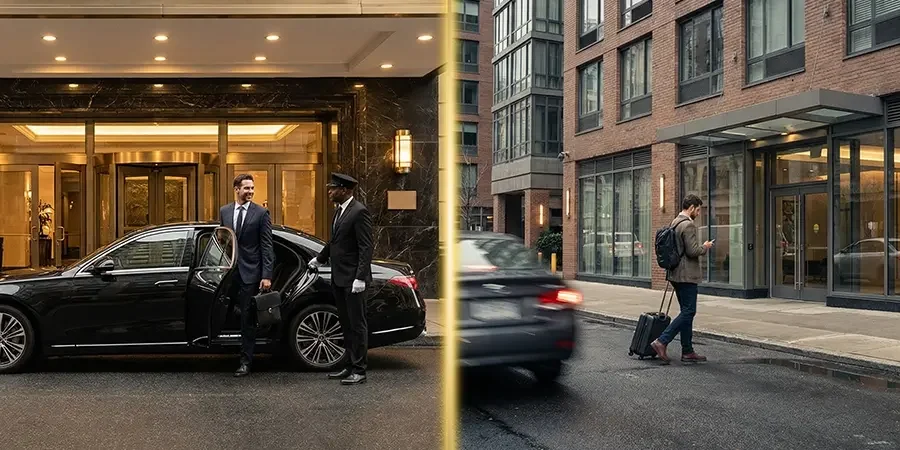

Business travel is not leisure travel with a laptop.
It’s logistics, reliability, predictability, compliance, and time economics.
Yet most “hotels vs Airbnb” articles stop at price tags and pillow preferences. That’s surface-level thinking, and it costs professionals real money, time, and reputation.
This complete business travel guide breaks down this hotels vs Airbnb situation through the lens that actually matters:
risk management, operational efficiency, duty-of-care, and productivity ROI.
Hotels vs Airbnb: The Business Travel Use Case
Before comparing platforms, define the business travel context. Business trips typically involve:
- Fixed schedules with low tolerance for disruption
- Early-morning airport transfers
- Confidential work, calls, or documents
- Corporate expense policies
- Zero margin for last-minute surprises
This context changes everything about the airbnb vs hotels debate.
Airbnb vs Hotels Pricing Comparison: What the Numbers Don’t Tell You
At first glance, Airbnb often looks cheaper, especially for longer stays. But business travelers must calculate total cost, not nightly rate.
Hidden Cost Layers in Airbnb Stays
- Cleaning fees and service charges
- Dynamic pricing fluctuations
- Cancellation penalties
- Self-managed logistics (check-in, keys, support)
- Productivity loss due to unreliable Wi-Fi or workspace
Hotel Pricing: The Predictability Advantage
- Transparent, standardized billing
- Loyalty programs and corporate rates
- Flexible cancellation windows
- Centralized service accountability
In real-world airbnb vs hotels pricing comparison, hotels frequently win once time, risk, and productivity are priced correctly.
Reliability & Accountability: The Core Difference
This is where hotels dominate for business travel.
Hotels
- 24/7 staffed operations
- Escalation chains for issues
- Brand-level accountability
- Standardized service delivery
Airbnb
- Individual hosts, variable standards
- No guaranteed response times
- Property-level inconsistencies
- Platform mediation delays
For executives, consultants, and corporate teams, uncertainty is the most expensive variable.
Security, Privacy & Compliance
Business travel involves sensitive data, devices, and conversations.
Hotels Offer
- Controlled access environments
- On-site security protocols
- Secure networks and workspaces
- Compliance alignment for corporate travel policies
Airbnb Risks
- Unknown access history
- Shared buildings or hosts
- Limited data security assurances
- Inconsistent safety standards
From a duty-of-care perspective, hotels remain the safer default.
Location Efficiency & Time Economics
Business travelers don’t “explore neighborhoods.” They optimize routes.
Hotels are strategically placed near:
- Airports
- Financial districts
- Convention centers
- Corporate hubs
When paired with professional ground transportation, such as a dedicated JFK car service, hotels create a frictionless travel ecosystem.
Airbnb locations, while sometimes attractive, often introduce:
- Longer commute times
- Inconsistent pickup access
- Navigation inefficiencies
Time lost is money lost.
Family & Extended Business Travel Considerations
For professionals traveling with children or on extended assignments, the decision becomes more nuanced.
When Airbnb Makes Sense
- Long-term relocations
- Multi-room requirements
- Kitchen access for dietary control
When Hotels Still Win
- On-demand services
- Reliable housekeeping
- Verified safety features like child safety seat coordination through professional transportation
- Concierge-level problem solving
Many business travelers now blend hotel stays with premium transport solutions like Car service to LGA Airport or private transfers for maximum control.
Business Travel Guide Verdict: Hotels vs Airbnb
Criteria | Hotels | Airbnb |
Reliability | High | Variable |
Security | Strong | Inconsistent |
Pricing Transparency | Clear | Fragmented |
Productivity | Optimized | Unpredictable |
Corporate Compliance | Aligned | Limited |
Hotels remain the superior choice for short-term, high-stakes business travel.
Airbnb can work for long-term, low-risk, self-managed stays.
The Smart Business Traveler’s Framework
Instead of asking “airbnb vs hotels?”, ask:
- How critical is schedule precision?
- What is the cost of disruption?
- Do I need guaranteed service escalation?
- How valuable is my time per hour?
Once these are answered, the choice becomes obvious.
Final Takeaway
Business travel is an operational exercise, not a lifestyle choice.
Professionals who understand this build their travel stack around predictability, accountability, and efficiency.
When accommodation decisions are paired with professional mobility solutions like NYC United Limo, the result isn’t just comfort, it’s control.
And in business travel, control is the real luxury.