How to Go From NYC to Boston: Complete Travel Guide
Every time someone searches “how to go from NYC to Boston,” they hit the same wall: four options, all of them claiming to be fast, affordable, or convenient. With no clear winner upfront, most people end up booking on price alone and regretting it later.
The problem is that surface-level comparisons leave out what actually matters: total trip time versus in-transit time, where you’re leaving from, whether you’re traveling alone or with a group, and how much your schedule can flex. A “1-hour flight” becomes a 5-hour commitment once you add airport time. A “cheap bus” can cost you an afternoon if you leave at the wrong time.
This guide cuts through that. Below, you’ll find a straight comparison of every option: train, bus, flight, driving, and private car, with real costs, honest timing, and a clear breakdown of who each option actually works for.
Side-by-Side Comparison: Train, Bus, Flight, Car
When comparing your options, it helps to look at them in one place; cost, time, and convenience often tell a very different story than marketing claims.
|
Travel Method |
Cost |
Travel Time |
Key Departure Points |
Best For |
|
Train |
$49–$200+ |
3.5–5 hrs |
Penn Station → South Station |
Fast, reliable city travel |
|
Bus |
$15–$40 |
4–5 hrs |
Port Authority Bus Terminal |
Budget-friendly trips |
|
Flight |
$99–$350+ |
~1 hr (4–5 total) |
JFK / LGA / EWR → BOS |
Specific time-sensitive cases |
|
Driving |
$35–$70 |
3.5–4.5 hrs |
I-95 North |
Flexible travel |
|
Private Car |
$400+ |
3.5–4 hrs |
Door-to-door |
Comfort & convenience |
Providers like Amtrak, Greyhound, FlixBus, Peter Pan Bus Lines, and OurBus operate heavily on this route. Prices verified as of March 2026
But these numbers only tell part of the story. To understand which option truly works best, you need to look at distance, traffic behavior, and real-world timing.
Distance and Typical Travel Time Between NYC and Boston
The journey covers roughly 215–230 miles via I-95 North, but real travel time depends heavily on conditions, not just distance.
According to the Federal Highway Administration, the I-95 corridor in the Northeast is one of the most heavily congested routes in the United States, particularly through urban and suburban segments.
What actually causes delays on this route:
- NYC exit traffic, especially between 3 PM and 7 PM
- Bottlenecks across Connecticut (one of the most unpredictable stretches)
- Summer weekends and major holidays
Even a minor slowdown in Connecticut can easily add close to an hour to your trip. That’s why many travelers start leaning toward options that avoid road congestion altogether—particularly trains.
Train Travel: The Most Reliable Way to Go From NYC to Boston
For travelers wondering how to go from NYC to Boston, trains strike the best balance between speed, comfort, and consistency.
Services operated by Amtrak run from Penn Station in NYC to South Station in Boston, offering direct, city-center to city-center connectivity without the need for transfers.
There are two primary options on this route. Acela Express is the faster service, typically completing the journey in about 3.5 hours with fewer stops and a quieter, more premium environment. Northeast Regional trains take slightly longer, around 4 to 5 hours, but are generally more affordable and widely available. To give you a concrete sense of pricing: a Northeast Regional ticket sampled in January 2026 was priced at $59 when booked 14 days out, the same trip within 48 hours of departure cost $112, nearly double. Book early.
What makes train travel stand out isn’t just speed, it’s predictability. Unlike road travel, trains operate along the Northeast Corridor, which avoids traffic congestion entirely. According to Amtrak Northeast Corridor data, this route is one of the most reliable intercity connections in the U.S.
Another important factor is total travel time. While flights may seem faster, trains often match or outperform them when you consider the absence of airport procedures.
That said, timing matters. Ticket prices, especially for Acela, can rise significantly within 24 to 48 hours of departure, making early booking essential for better value.
For travelers considering cheaper alternatives, though, buses offer a very different trade-off.
Bus Services: The Most Budget-Friendly Option
Buses remain the most affordable way to travel between NYC and Boston, making them especially popular among students and budget-conscious travelers.
Operators such as Greyhound, FlixBus, Peter Pan Bus Lines, and OurBus provide frequent departures from the Port Authority Bus Terminal, with Peter Pan offering the most consistent on-time arrivals during weekday mornings, making it a reliable choice for business travelers.
Travel time typically ranges between 4 and 5 hours, but unlike trains, buses share the same roads as cars, meaning traffic plays a major role. Data referenced by the Port Authority of New York and New Jersey shows that peak outbound traffic periods significantly affect departure consistency.
In practice, early morning departures, especially before 8 AM, tend to be more reliable, as they avoid the worst of NYC congestion. Evening routes, on the other hand, are more likely to face delays.
While buses are cost-effective, the trade-off comes in the form of comfort and variability in travel time.
For travelers who think speed is the priority, flying might seem like the next logical option, but that assumption doesn’t always hold up.
Flying From NYC to Boston: Fast in the Air, Slower Overall
Flights between NYC and Boston are short, typically around one hour in the air. However, total travel time tells a more complete story.
Departures operate from John F. Kennedy International Airport, LaGuardia Airport, and Newark Liberty International Airport, with arrivals at Logan International Airport.
According to the Transportation Security Administration, travelers should arrive at least 1.5 to 2 hours before domestic flights, which adds significantly to total trip time.
According to the Transportation Security Administration (TSA), travelers should arrive at least 1.5 to 2 hours before domestic flights, which adds significantly to total trip time.
Once you factor in airport transfers, security checks, boarding, and post-arrival transit into Boston, the journey typically extends to 4–5 hours, similar to trains and buses.
Flying makes the most sense in specific scenarios, such as connecting flights or proximity to airports. Otherwise, the added complexity often outweighs the time saved in the air.
For travelers who prefer full control over their journey, driving presents another option, but with its own challenges.
Driving From NYC to Boston: Flexible but Traffic-Dependent
Driving is another way to consider how to go from NYC to Boston, giving you full control over timing, stops, and route choices.
The standard route follows I-95 North, covering approximately 215–230 miles. Under ideal conditions, the journey takes about 3.5 to 4.5 hours.
However, as highlighted by regional traffic studies from the Federal Highway Administration, this corridor is one of the most congestion-prone in the Northeast.
The Connecticut segment, in particular, is known for unpredictable slowdowns. Combined with NYC departure traffic and weekend congestion, travel time can vary widely.
Costs also add up, fuel, tolls, and Boston parking (often $30–$50 per day) make driving less economical than it initially appears.
Driving tends to work best for groups or travelers who value flexibility over predictability.
For those looking to avoid both traffic stress and logistical planning, a more seamless option exists.
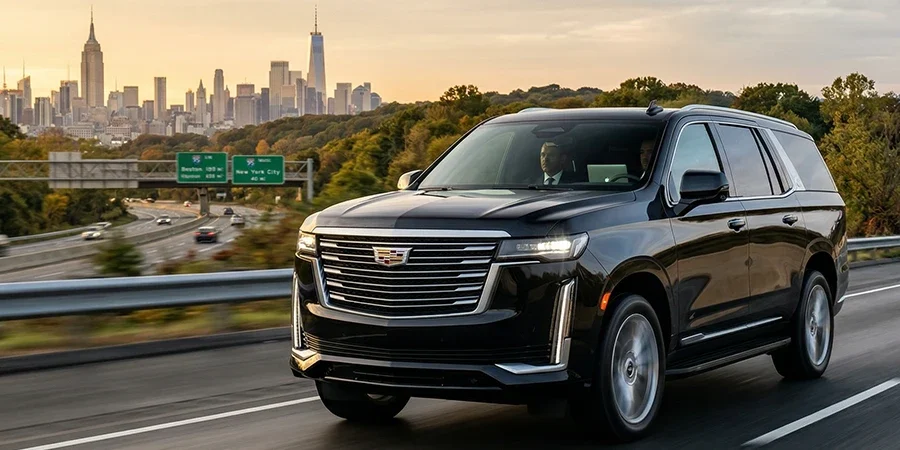
Private Car Service: The Most Seamless Door-to-Door Option
Private car service covers the same 215–230-mile route door-to-door, with pricing typically starting at $400+.
Travel time mirrors self-driving, roughly 3.5 to 4.5 hours, depending on traffic, but the key difference is that a professional chauffeur handles all navigation and routing decisions. There are no transfers, no parking to arrange, and no schedules to match.
The trade-off is straightforward: a private car is the most expensive option on this route. It becomes more cost-effective when the fare is split among a group, or when the value of a guaranteed, hassle-free experience outweighs the premium, as is often the case for business travel or time-sensitive trips.
At this point, the best choice depends less on the route and more on your travel priorities.
Which Travel Option Makes the Most Sense for You
After coordinating thousands of NYC to Boston transfers, here is how we have seen travelers make this decision.
- If cost matters most → Bus
- If reliability and balance matter → Train
- If flexibility matters → Driving
- If comfort and ease matter → Private car
- If you’re connecting flights → Flying
In most cases, the train offers the best overall balance, but the right choice depends on your situation.
Important Travel Tips to Save Time and Stress
A smoother trip often comes down to timing and preparation rather than the method itself.
Timing is the single biggest lever you can pull. Avoid departing on Friday evenings, outbound I-95 traffic from NYC peaks between 3 PM and 7 PM on Fridays, and can add 60 to 90 minutes to any road-based journey, including buses. If you’re taking the train, book as early as possible: Amtrak fares on this route can nearly double within 48 hours of departure, so booking a week or two out makes a real difference.
Always compare total trip time, not just in-transit time. A one-hour flight looks faster than a four-hour train until you add two hours of airport procedures, transit to the terminal, and the ride from Logan into downtown Boston. For most city-center-to-city-center trips, the train is competitive or faster on a door-to-door basis.
If you’re traveling with checked luggage, minimize transfers wherever possible. Every connection, whether a train change, a rideshare to the airport, or a shuttle from the terminal, adds friction and risk. Direct routes, whether by train or private car, keep your bags with you and your schedule intact.
FAQs About Traveling From NYC to Boston
What is the best way to travel from NYC to Boston overall?
The train is the best overall option for most travelers. It offers a reliable, traffic-free journey and takes about 3.5 to 5 hours between city centers. If you’re on a budget, buses are cheaper. For flexibility, driving works better, while private car services offer the most convenience.
Is Amtrak worth it compared to driving or flying?
Yes, Amtrak is often the most practical choice. It avoids traffic delays and typically matches or beats flights in total travel time. Acela is faster and quieter, while the Northeast Regional offers better value for most travelers.
What is the cheapest way to get from NYC to Boston?
Bus services are the cheapest option, with fares starting around $15–$30 when booked early. However, travel times can vary due to traffic, and comfort levels depend on the operator and departure time.
Is flying from NYC to Boston actually faster?
Not usually. While the flight takes about an hour, the total travel time is typically 4 to 5 hours due to airport procedures. For most travelers, this makes flying similar to—or slower than—the train.
When does driving make the most sense for this trip?
Driving works best for group travel or when you need flexibility in timing and stops. Avoid peak NYC hours, especially Friday afternoons, as traffic can significantly increase travel time.
Is a private car service worth it for NYC to Boston travel?
For business travelers or families, fixed pricing and door-to-door pickup make the trip stress-free. A private car service like NYC United Limo offers professional chauffeurs, reliable timing, and a comfortable, controlled experience, ideal for important or time-sensitive trips.
What is the most reliable option with the least delays?
Trains are the most reliable because they are not affected by road traffic. Buses and cars face delays on I-95, while flights can be impacted by airport congestion and weather.
How far in advance should I book tickets?
Book at least a few days in advance for the best prices and availability. Train fares rise quickly within 24–48 hours, while early booking helps secure cheaper bus and flight tickets.