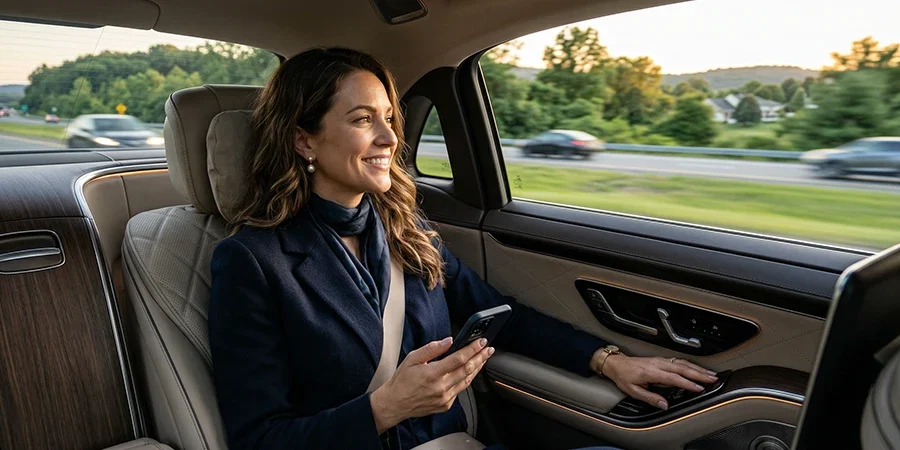

You’ve got a flight out of JFK. You’re in Philadelphia. And you’re already doing the math, 95 miles, how hard can it be?
This route comes with several potential points of delay. A missed subway connection in Manhattan, traffic on the NJ Turnpike near Newark, or taking the wrong AirTrain at Jamaica Station can quickly disrupt your schedule and put your flight at risk.
This guide breaks down every realistic option, train, bus, private car, and driving, with specific costs, transfer instructions, and the timing framework you need to arrive at JFK on time, every time.
Quick Answer for Travelers in a Hurry
- Fastest door-to-terminal: Private car — 2 to 2.5 hours, zero transfers
- Best public transit: Amtrak + E subway + AirTrain — 2.5 to 3.5 hours
- Cheapest: Bus to Port Authority + subway + AirTrain — under $45 total
- Best for groups or heavy luggage: Private SUV or Sprinter, direct to the terminal
- Key fact: No direct rail link between Philadelphia and JFK exists — every train option requires at least one Manhattan transfer
The right answer depends on your budget, luggage, and tolerance for multi-step connections. Here’s exactly how each option works.
Understanding the Route Before You Choose
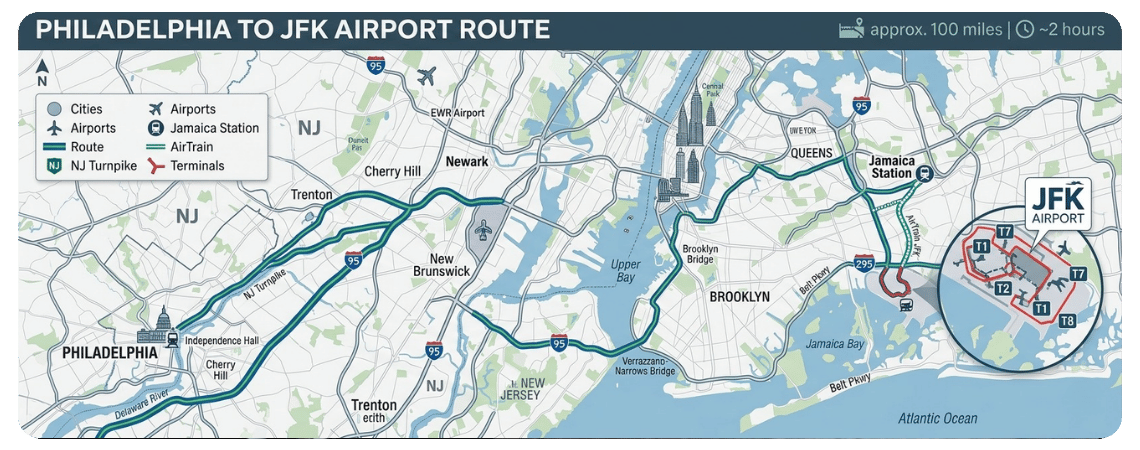
The driving distance from Philadelphia to JFK is 95–109 miles, depending on the route taken. Best-case driving time is just over two hours under light traffic. You’ll cross two state lines, travel the length of the NJ Turnpike, one of the most congested corridors in the northeastern US, and arrive in Queens, not Midtown Manhattan.
This means you’re not estimating travel time based on mileage. You’re estimating it based on day of the week, departure hour, and how much buffer you’re willing to carry. A 5 p.m. Thursday departure from Philadelphia can take 3.5 hours. The same trip on a Tuesday morning takes 2.
One thing most guides don’t mention: JFK’s AirTrain runs in a one-way loop through all six terminals. If you board heading the wrong direction, you’ll complete nearly the entire loop before reaching your terminal, adding 15 to 20 minutes you simply don’t have when you’re cutting it close. Know your terminal number before you step onto the platform.
With that understood, here’s how each option performs.
The Best Ways to Get From Philadelphia to JFK
Train + Subway — Most Reliable Car-Free Option
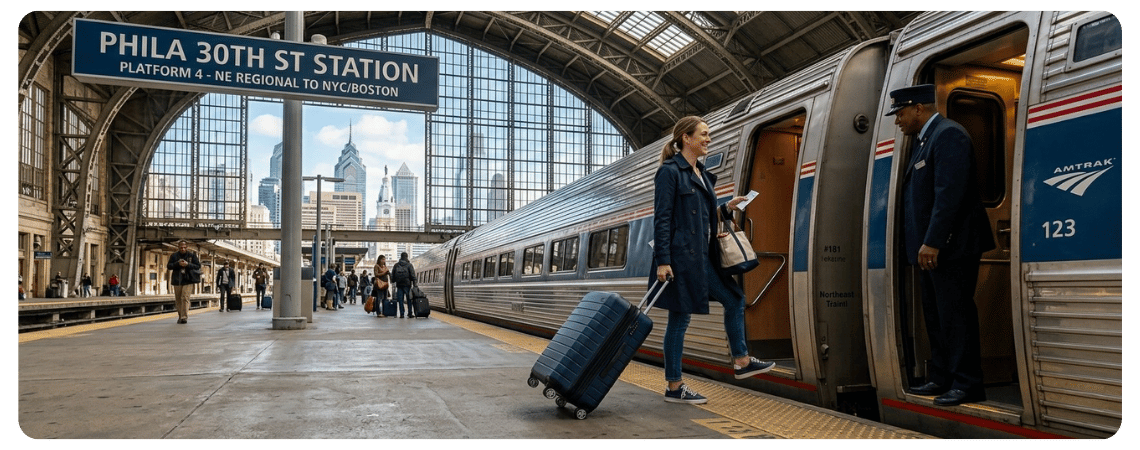
Amtrak’s Northeast Regional departs Philadelphia 30th Street Station roughly every 30 minutes. Travel time to New York Penn Station: approximately 1 hour 21–26 minutes. Advance fares start at $12–$19 for Regional service. The Acela covers the same route in about 1 hour and 11 minutes at a higher fare.
From Penn Station, take the E train to Jamaica Station in Queens, roughly 35–40 minutes, then the AirTrain to your terminal (10–15 minutes). AirTrain fare is $8.75, paid separately at Jamaica (jfkairport.com). Subway fare is $3.00.
A smarter alternative for the Manhattan–JFK leg: the LIRR from Penn Station to Jamaica takes roughly 20 minutes, nearly half the E train time. Peak fares run $7.25–$16; off-peak $5.25–$14. From Jamaica, the AirTrain connection is identical either way.
Total realistic time, Philadelphia to JFK terminal: 2.5 to 3.5 hours. Best for solo travelers with manageable luggage and no extreme time pressure.
Bus + Subway — Cheapest, Highest Risk
FlixBus and similar operators run from Philadelphia to the Port Authority Bus Terminal (42nd Street) for $13–$29. Journey time is approximately 2 hours under normal conditions, but buses are far more exposed to NJ Turnpike traffic than Amtrak, which runs on a dedicated rail corridor insulated from highway congestion.
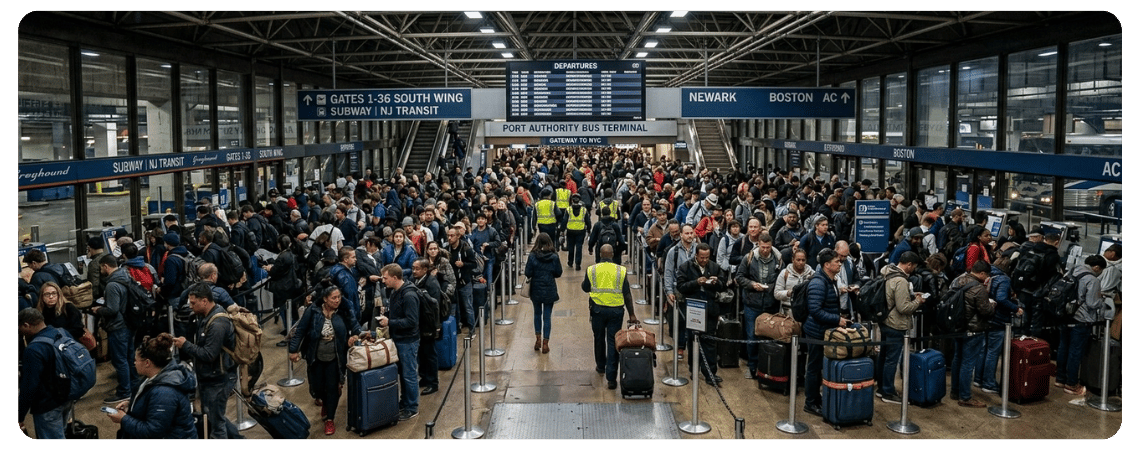
From Port Authority, connect via the same E train + AirTrain route above. Total door-to-terminal time: 3 to 4.5 hours.
This is the most affordable option, but the most transfer-heavy and the least resilient when delays hit. Choose it only when budget is the sole deciding factor and your timeline is genuinely flexible.
Private Car Service — Direct, No Transfers
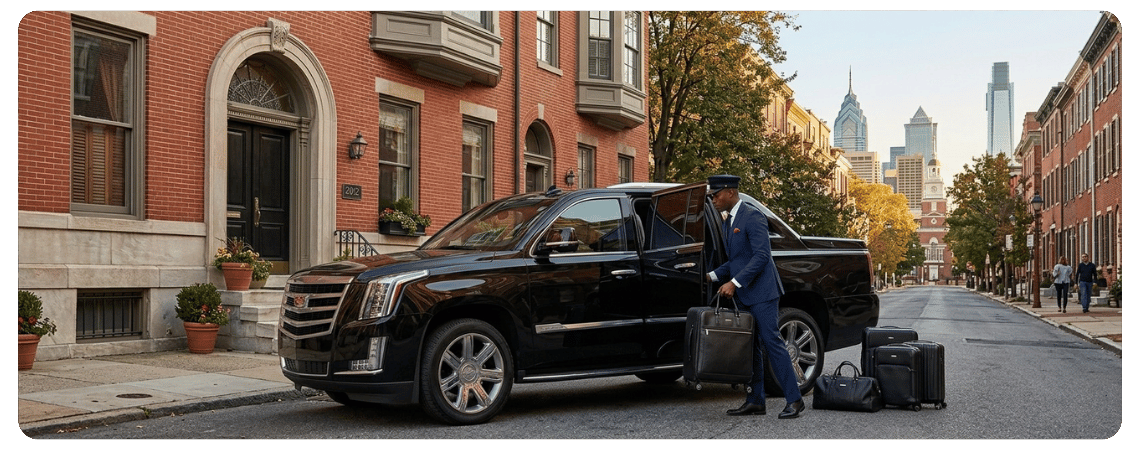
A pre-booked private car is the only door-to-terminal option on this list. No transfers, no subway staircases, no luggage juggling across three platforms. Under favorable traffic, the drive runs 2 to 2.5 hours.
Most professional car services offer flat-rate pricing agreed at booking, so your fare doesn’t change if traffic on the Turnpike adds extra time. Rideshare apps, on the other hand, use dynamic pricing, meaning peak-hour departures from Philadelphia can cost significantly more than the same trip booked during off-peak hours.
When comparing providers, look for services that include essentials like flight monitoring, experienced drivers familiar with airport routing, and clear pickup coordination. These small details make a noticeable difference on a route where timing matters.
For example, established providers like NYC United Limo structure these trips around fixed pricing, real-time flight tracking, and direct terminal drop-offs, removing the uncertainty that often comes with multi-step travel.
For business travelers, families, or anyone with checked luggage, this eliminates every transfer friction point on a genuinely complex route.
Driving Yourself — Flexible but Risk-Prone
Driving gives you the most schedule control. Standard route: I-95 North to the NJ Turnpike, then the Van Wyck Expressway into JFK. The Belt Parkway via Brooklyn is sometimes faster in practice, depending on conditions.
The real complications: JFK short-term parking runs $4–$6 per 30 minutes; long-term lots are cheaper but require a shuttle to the terminal. On a multi-day trip, parking costs alone frequently exceed the price of a pre-booked car service. Traffic on the NJ Turnpike is genuinely unpredictable in ways that Amtrak is not.
Best suited for day trips, or one-way travel where someone can drop you curbside.
Best Times to Travel — and What to Avoid
Departing Philadelphia between 7 and 9 a.m. on weekdays means hitting both Philadelphia’s outbound commute and the NJ Turnpike at peak congestion simultaneously. The 9:30 a.m. to noon window is consistently the smoothest for road-based options.
Evening travel after 4 p.m. on weekdays reintroduces serious risk. The Turnpike approach to New York is one of the country’s most reliably congested stretches, a 20-minute delay near Newark regularly cascades into an hour before you reach JFK.
Weekend travel is meaningfully easier for all road-based options. If you have flexibility on departure day, Tuesday through Thursday mornings represent the lowest-friction window on this entire route.
Realistic Buffer Times Before Your Flight
Option | Buffer Needed Before Check-In |
Private car (direct) | 45 minutes |
Amtrak + LIRR + AirTrain | 2 hours |
Amtrak + E subway + AirTrain | 2.5 hours |
Driving / rideshare (off-peak) | 2 hours |
Driving / rideshare (peak) | 3+ hours |
Bus | 3.5 hours |
These are minimums, not targets. Build in more whenever weather, a weekday rush, or a complex check-in is involved.
Which Option Is Right for You?
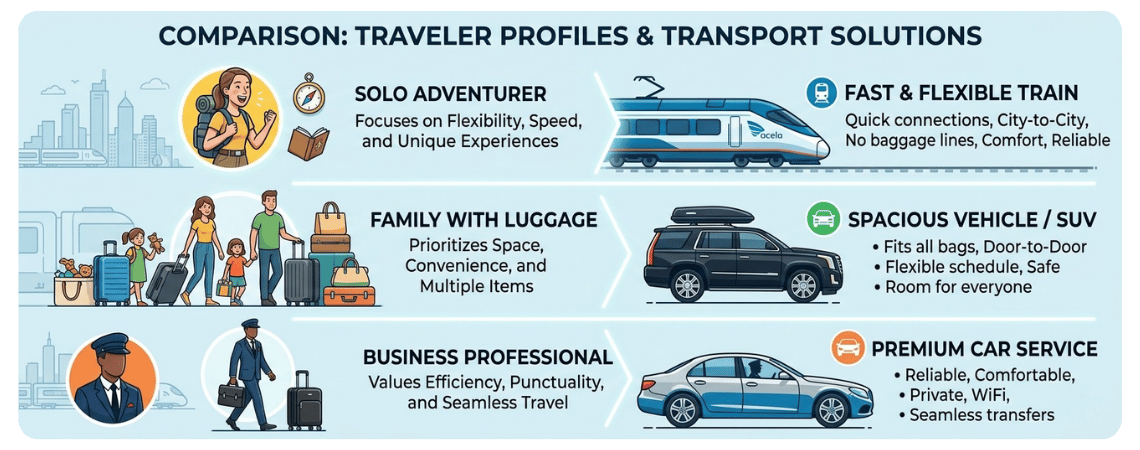
Business travelers on tight schedules: Pre-booked private car. Total travel time is comparable to the best-case train scenario, but without three transfer points and no dependence on subway timing.
Families and heavy luggage travelers: Private SUV or Sprinter, full stop. The subway and AirTrain combination is workable for a solo traveler with a carry-on. It is genuinely difficult for two adults with four checked bags and a child.
Budget-conscious leisure travelers: Amtrak to Penn Station + LIRR to Jamaica + AirTrain. Budget $40–$60 total, book Amtrak in advance for the lowest Regional fares, and check MTA service alerts before leaving Penn Station.
FAQs
Does a direct train from Philadelphia to JFK exist?
No. Every rail option requires at least one transfer. Amtrak arrives at Penn Station in Manhattan, and travelers connect to the E/J/Z subway or LIRR to Jamaica, then the AirTrain. No direct Philadelphia-to-JFK rail route currently exists.
What’s the fastest door-to-terminal option?
A pre-booked private car service or SUV. Under favorable traffic, expect 2 to 2.5 hours with no transfers.
LIRR or E train from Penn Station, which is better?
LIRR. It reaches Jamaica in roughly 20 minutes versus 35–40 minutes on the E train. If you’re connecting to the AirTrain at Jamaica, the LIRR saves meaningful time and reduces transfer complexity on an already long travel day.
Is car-free travel to JFK from Philadelphia practical?
Completely, for most travelers. Amtrak + LIRR + AirTrain is well-established and runs throughout the day. The main limitation is luggage; multiple large bags make the subway and AirTrain connections genuinely tiring. Solo travelers or pairs with carry-on luggage will find it practical and affordable.
What should I do if my Amtrak train is delayed?
Check the MTA service status before departing Penn Station. If the delay is significant and you’re traveling by car service, contact your operator; most licensed services will adjust pickup times at no additional charge when notified in advance.