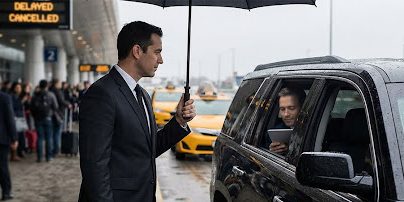

Travel disruptions rarely announce themselves politely. They arrive through delayed flights, closed attractions, staffing shortages, and a creeping uncertainty that changes how people move, even before official advisories are issued.
The recent U.S. government shutdown offers a useful case study, not because shutdowns are new, but because they expose stress points in the travel system that usually remain invisible during normal operations. While airlines and airports occupy the spotlight, luxury car service quietly absorbs much of the downstream impact. (source)
Disruptions Don’t Just Cancel Trips, They Change Behavior
One of the most significant findings from shutdown-related travel analysis is not simply the reduction in trips, but the change in traveler decision-making. High-net-worth leisure travelers and executives tend to respond differently to uncertainty than price-sensitive segments. Instead of abandoning travel altogether, they re-optimize for control.
This often means:
- Reducing friction on arrival and departure
- Minimizing transfer risk between modes
- Prioritizing time accountability over flexibility
Considering this, A luxury car service becomes the stabilizing variable in an otherwise volatile journey.
Airports as Dependency Nodes, Not Isolated Facilities
Airports are not standalone entities. They rely on federal staffing, local infrastructure, and synchronized operations across security, customs, and air traffic control. When one component slows, the effects cascade outward, impacting curb access, pickup timing, staging rules, and passenger flow.
Professionally managed chauffeur services are structurally designed to operate within this complexity. Dispatch teams track flight irregularities, adjust arrival timing, and absorb delays without transferring the burden to the traveler. This becomes especially relevant during periods of government-driven disruption, when airport conditions can change hour by hour.
The Quiet Difference Between Transactional and Managed Mobility
Not all car service providers operate on the same logic. Transactional models prioritize immediacy and volume. Managed services prioritize pre-commitment and execution.
During stable conditions, the difference may appear marginal. During disruptions, it becomes decisive.

Human oversight rather than purely algorithmic matching: Ensuring personalized care.
These elements are not about luxury signaling; they are about reducing failure points.
Airport Transfers as Risk Containment
Airport transfers are where disruption risk concentrates. Delayed landings, gate changes, customs backlogs, and staffing shortages compound into missed connections and lost time.
In response, travelers increasingly treat airport ground transport as a risk-containment function, not a ride. The expectation shifts from “get me there” to “handle this without my involvement.”
This is particularly evident in New York and neighboring states, where airport congestion magnifies even minor operational slowdowns.
Corporate Travel Learns the Lesson First, Leisure Follows
Corporate travel historically adopts reliability-first behaviors before leisure travelers. What is changing is that high-end leisure travel now mirrors this mindset. Private itineraries increasingly resemble corporate ones in structure: fixed schedules, advance planning, and minimized uncertainty.
Hourly as-directed services and long-distance interstate travel (within compliant regional corridors) reflect this shift. Travelers want continuity across meetings, events and border crossings without renegotiating transport at each step.
Chauffeurs as Operational Insurance
The concept of chauffeurs as “operational insurance” is gaining quiet traction. Not insurance in the legal sense, but in the practical sense of accountability when systems underperform.
When something goes wrong, someone is responsible, reachable, and empowered to act. That expectation is becoming non-negotiable for a growing segment of travelers.
What This Means for Travelers Going Forward
Travel disruptions are unlikely to disappear. Whether driven by policy standoffs, labor shortages, or infrastructure strain, uncertainty is becoming a permanent feature of mobility.

These preferences are reshaping how ground commute fits into the broader travel experience, quietly but decisively.
As a countrywide recognized NYC car service operator serving New York and the tri-state region, NYC United Limo operates within this evolving reality, where preparedness, planning, and discretion increasingly define what “premium” actually means.